
By Melanie Lenehan
Fircroft College of Adult Education celebrates its 110 years anniversary in 2019. The college was set up in 1909 by George Cadbury Jr and its first warden Tom Bryan following a trip to Denmark where they discovered the Danish folk high schools. Following further visits, two Danes were amongst the first 12 students enrolled at Fircroft. The college is the only surviving example of the residential influence of the Danish folk high school in England. Bryan’s first visit in 1904 convinced him that the secret to a new model was education and co-operation and the latter is readily dependent on the former.
The main features in common with the Danish folk high schools were the insistence on the value of residence and some particular features which were defined as:
- Comradeship of the teacher and the scholar
- The freedom of discussion
- Care of the individual
Tom Bryan felt the tutorial (as was the current model in adult education in the 1900’s) did not bring to the workers the best that the older universities have to bestow. He coveted the experience of college life for the common people of England. Cadbury felt that politically and industrially men must learn to co-operate. That was designed through residency, working together in the things of the mind and in things practical. Fircroft was to be a “poor man’s university”. It sought to make men aware of the living truth. Bryan felt that “the true education is not preparation for examination but a preparation for life”. So the core elements of citizenship, co-operation, collaboration, and a particular pedagogical approach in its early history were all influenced by Grundtvigs thinking.
Residential Environment
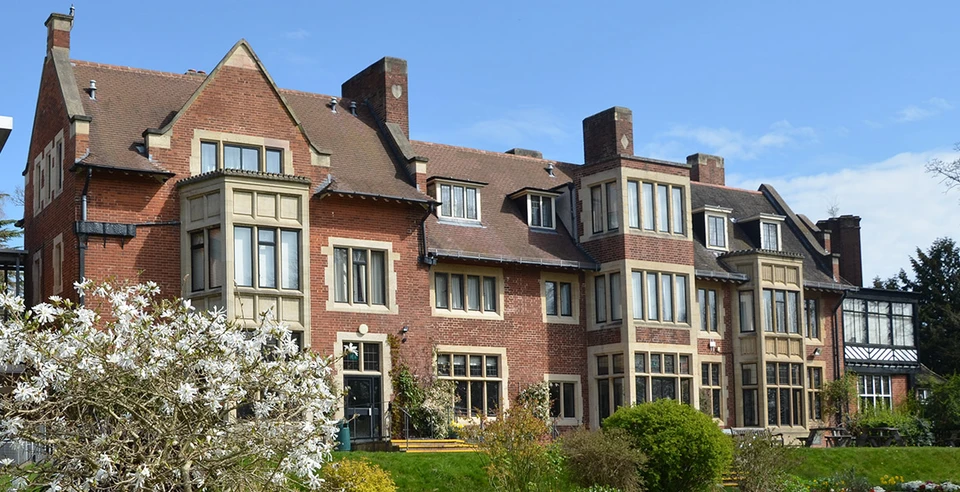
Fircroft College is situated in a unique, beautiful and historic space, in Cadbury’s family home built in 1902. Our learners say that the beauty and value of the historic buildings and grounds make the learners feel valued themselves, it “gets away from such spaces only being for the rich”. Most of our learners have never had such experiences. They feel privileged and special to be able to access and learn in such environments. They say: “You have got all these fantastic gardens… you can have access to these grounds and you can walk round them and switch off completely.” For many, residency and the grounds were the key defining factors in choosing to study at the college. In a recent research report of the residential colleges in England, learners saw access to such buildings as restorative, conferring “social justice” on people from working class or disadvantaged backgrounds.
Fircroft College is situated in a unique, beautiful and historic space, in Cadbury’s family home built in 1902. Our learners say that the beauty and value of the historic buildings and grounds make the learners feel valued themselves, it “gets away from such spaces only being for the rich”.
Melanie Lenehan
Most learners attending the residential adult education colleges have experienced or are still experiencing some form of disadvantage; through previous negative experiences in education resulting in low levels of qualifications and consequentially economic disadvantage; life choices which have resulted in drug and alcohol addiction and/or criminal activity and for high numbers of students mental health issues, either as a result of or independently of the above. Some learners may also have learning difficulties which may or may not have been diagnosed. “Some of us do not have ideal lives, we have stuff going on that we could have got caught up in.” Residential education works for our learners. All the residential colleges have high success rates which are significantly above national benchmark data on both short courses and Access to Higher Education programmes and student satisfaction ratings are amongst the highest in England (ESFA Student Satisfaction Survey 2018).
Sharon Clancy and John Holford report on the residential colleges “Life-changing things happen” from 2017 found that the college generates a sense of safety, security, retreat and refuge for people often stepping out of difficult home lives and that this was vital to learners who had often had traumatic life experiences, such as domestic violence, homelessness, or were seeking asylum from the hard realities of unemployment and trying to make a living in precarious or unstimulating work. Many learners talked about the inclusive nature of the college, welcoming people from all backgrounds. They describe the ethos, “you can feel the energy running through the place”.
Togetherness, community and fellowship
In the research on the residential colleges in England, many learners described the social benefits and the sense of community which resulted from living and learning with fellow learners in a small and intimate environment. “You’re surrounded by other people who motivate you.”
Within this atmosphere participants confirm they feel a sense of community and fellowship, becoming immersed in an intensity of learning, and at times change profoundly, creating new lives and opportunities for themselves and others.
Having a room to retreat to, with a desk, bed and shower, after a day of intensive learning, is perceived as an important aspect of the sense of being in a sanctuary for learning.
Melanie Lenehan
Many learners described the social benefits and the sense of community which resulted from living and learning with fellow learners, in a small and intimate environment. For many learners being able to stay on-site enables them to concentrate and focus on the learning experience, instead of being preoccupied with childcare, or the daily commute, or having to cook and clean for themselves. Having a room to retreat to, with a desk, bed and shower, after a day of intensive learning, is perceived as an important aspect of the sense of being in a sanctuary for learning. A significant additional advantage of being residential is access to the library during both the day and night.
The residential education model means our learners place great emphasis on peer group support and learning from each other’s views and personalities. They tell of feeling empowered by seeing “people like me achieving and succeeding”. The resulting connections with others are “mutual, creative, energy-releasing and empowering for all participants”.
We are a very diverse education community. For many of our learners failed by the school system, the college offers a 2nd, 3rd or last chance to access education and make some changes in their lives. Their engagement with the college can contribute to their social mobility. Our learners come from all walks of life and can be any age over 19. This provides an incredible richness of experiences, views and opinions.
Transformative learning and critical pedagogy
Tom Bryan introduced a very personal and different approach to teaching and learning at the beginning of Fircroft College which were; teacher and student as equals “comrades in the quest for truth”, and “a good teacher must have the faculty for friendship”.
These principles, influenced by the concept of enlivenment, are alive and well in the residential college. Our learners say that their experience fosters critical thinking and a radical understanding of politics and society, and that challenges the mainstream and the establishment view. It “changes the way we think about the world”. Debate, dialogue and exchange lead to thorough and engaged learning. In residential colleges these happen both inside and outside of the classroom, at the coffee machine, over breakfast, lunch and dinner and in the evenings after classes have finished. Our learners describe “conversations as learning”.
Our learners say that their experience fosters critical thinking and a radical understanding of politics and society, and that challenges the mainstream and the establishment view. It “changes the way we think about the world”.
Melanie Lenehan
Transformative learning is described by Jack Mezirow in his book Transformative Dimensions of adult Learning as “the process by which we transform problematic frames of reference, to make them more inclusive, discriminating, open, reflective and emotionally able to change.” We argue that residency creates the conditions in which transformative learning can happen in a very rapid way.
Many of our adult learners enrol at a point of transition, or what Mezirow would call a disorientating dilemma. According to Mezirow, transformative learning starts with a disorienting dilemma. The lecturer in Diferentiated Pedagogies at the University of Malta, Dr. Colin Calleja, writes that this is one of the major phases that such adult learners go through in their personal transformation. Usually this is triggered by a life crisis or a major transition. Many of the learners within the residential colleges are, as a result of their disorienting dilemma, dealing with some form of life transition.
Research with referral partners at Fircroft College discovered that they view the residential colleges as key providers of the support and environment needed to help progress their clients on to a further stage in their development. In their rehabilitation, the involvement with colleges tends to occur once they had already reached a point of stability and were perhaps nearing the end of their “treatment”. At that stage our referral partners feel integration is a really important outcome which residential adult education can provide because our cohorts are so diverse. In our partner research they describe residency as a “supercharged educational experience”.
For many of our learners, the residential short course delivery model, an intensive transformative learning experience of 48 hours, can be a more achievable commitment in terms of their physical and mental health and well-being and other issues in their lives. It also enables significant outcomes to be achieved in a very short space of time. For learners accessing longer courses over nine months, usually Access to Higher Education, there is more time for extended activity, skills development and practice and access to tutors and support staff. At Fircroft College, 95% of learners say the residential environment supports their learning. As one learner describes, “the main aspect was the atmosphere. And it was very quiet and totally different to a Further Education college in the sense that it is always hustly bustly and very hectic, students go in for one thing and run out… the college is much more student focused, and that is what makes this residential stand out from the rest”.
“the main aspect was the atmosphere. And it was very quiet and totally different to a Further Education college in the sense that it is always hustly bustly and very hectic, students go in for one thing and run out… the college is much more student focused, and that is what makes this residential stand out from the rest”.
Student at Fircroft College of Adult Education
We still recognise the role of tutor and learners as equals. The small nature of the college allows for getting to know tutors and feeling that they can be approached as equals. Time outside the programmed lessons, for example mealtimes or sharing a coffee, is an opportunity for learners to get to know the tutor and vice versa.
Our learners say, “the tutors here and their services and support networks are outstanding, no words, there are no words to describe this place really, other than it is a safe haven, a sanctuary for your education, for your health, for your mental health…”.
The use of a critical, pedagogical approach in the residential college makes full use of experiential learning. Our tutors embed the lived experience of our learners as part of content but always ensure this is within educational boundaries.
We have also been exploring the notion of creating “brave spaces”. Though seemly contradictory, safe spaces need to enable bravery to take risk, to change and challenge to try out new perspectives, to hear and respect others. Our learners say: “You’re out of your comfort zone. You know you are out of your comfort zone because you are doing something new, but you’ve got the immense support of everybody around you.” Michael Leiven and Keith Jackson, in their paper “Encouraging Citizenship”, observed that residential learners “experience changed roles and an interruption to their usual patterns of living. They see themselves in new ways and can risk doing things which they previously considered beyond their scope, or in some way unacceptable within their everyday roles, they take new risks in challenging themselves culturally and intellectually”. Colin Calleja would say this is about “reintegrating the new perspective into life and acting it in the social dimension”.
Ultimately residential adult education provides transitional places and transformative spaces that allow adults to have access to choices and opportunities. It provides a community and environment that gives hope and builds pride and ambition. For Jean Anderson Fleming, assistant professor of adult and community education at Ball State University, the residential dynamic seems to capture and envelope the whole learner, enabling them to bring all of themselves to the learning and to take away from that experience all they are able to take. For adults in transition and experiencing transformation this can be not only effective but life changing.
